Why Greeks Say ‘Opa!’ (And No, It’s Not Just for Smashing Plates)
Opa! It is the universal call of celebration in Greece, but there is way more to it than smashing plates. Join me as we explore the roots, meanings, and significance of this delightful Greek exclamation.
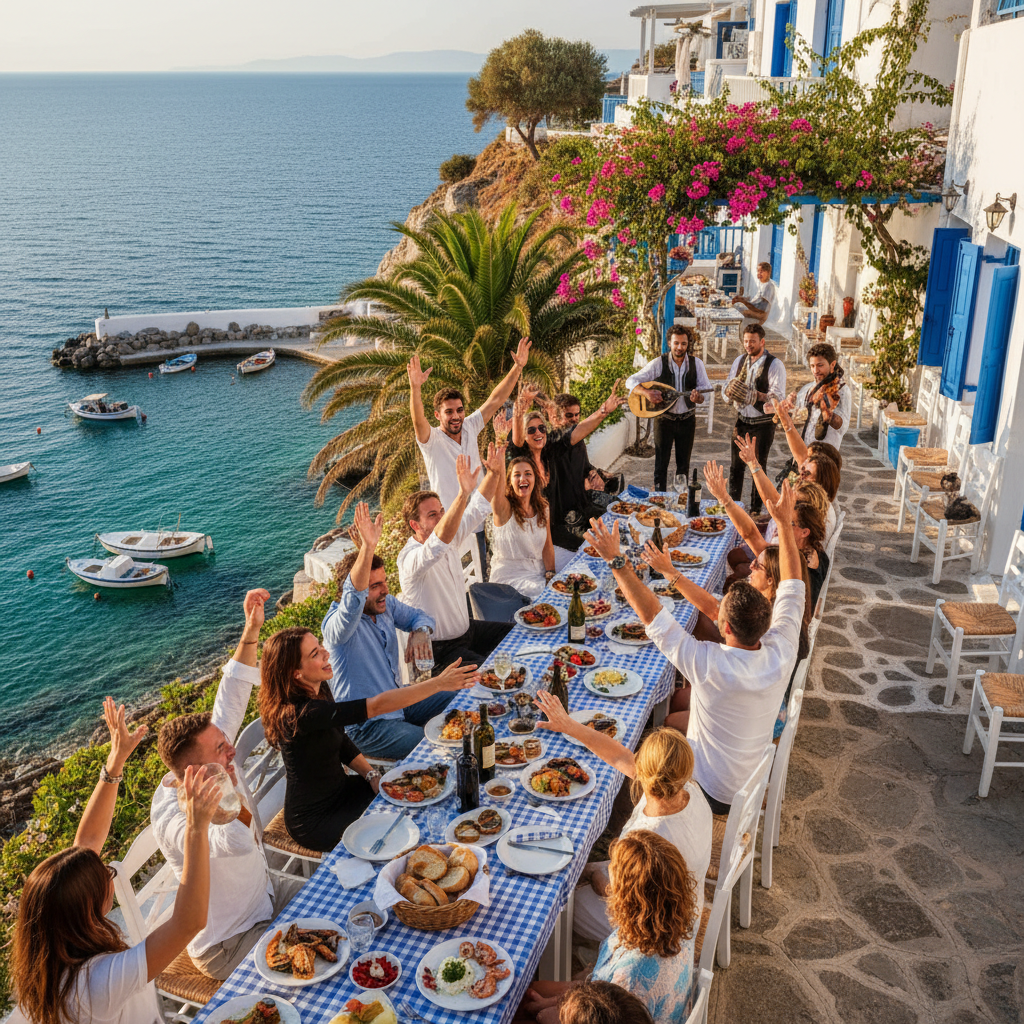
Ah, ‘Opa!’ A word that rolls off the tongue like a fine chilled glass of ouzo after a long, sweltering day of sun and sea. If you have ever had the pleasure of experiencing a true, blue-blooded Greek celebration, you have likely been swept up in this joyful, thunderous declaration that often accompanies everything from exuberant plate-smashing to some truly questionable, limb-flailing dance moves. But let us not get ahead of ourselves with the dramatics just yet!
‘Opa!’ is far more than just a call to absolute mayhem. It is a multi-faceted expression tied deep into the very heart and soul of Greek culture. So let us dive into the meaning behind this exuberant cry and why it truly encapsulates the rich, chaotic, and beautiful tapestry of the Greek lifestyle.
What You Will Learn
-
The ancient linguistic roots behind the word ‘Opa!’
-
Why we actually smash plates and what it signifies for the soul.
-
How to use the word correctly in your daily Greek life.
-
The surprising role ‘Opa!’ plays as a coping mechanism for everyday disasters.
-
Practical tips for blending in at a local taverna without looking like a total tourist.
The Roots of ‘Opa!’
To really get under the skin of ‘Opa!’, we need to peel back the layers of Greek history like a well-cooked, steaming moussaka. Some linguists suggest its origins can be traced back to the ancient Greek word ‘opas’, which essentially meant to awaken or to see. As the centuries rolled on, that original meaning evolved into an expression of raw enthusiasm and sheer joy.
Today, Greeks use ‘Opa!’ to celebrate, to react to spontaneous moments of clumsiness, or simply to spice up a rather dull conversation at the village square. It is a linguistic Swiss Army knife of emotion. Whether you are at a high-end wedding in Santorini or a dusty back-street café in Athens, you will hear it floating on the breeze like the scent of oregano.
In various settings, ‘Opa!’ encapsulates a whole range of human feelings:
-
Joy: Whenever we are doused in celebrations, be it weddings, christenings, or a Tuesday night feast, ‘Opa!’ lights up the atmosphere like a firework.
-
Surprise: That precarious, heart-in-mouth moment when someone trips on the dance floor and almost loses their drink—expect an immediate, delighted ‘Opa!’
-
Community Bonding: It acts as an audible glue, calling everyone together to celebrate shared moments over a table groaning under the weight of lamb chops and tzatziki.
The Celebration Factor
Now, let us step into the lively, noisy world of celebrations where ‘Opa!’ truly shines like gold in the Grecian sun. You will most often hear this exuberance echoed among the wooden tables of family-run tavernas. Picture this: you are surrounded by loved ones, the table is littered with plates of tzatziki and spanakopita, and a robust red wine is flowing like the Aegean waves against the shore.
Then, someone suddenly throws their arms up, lets out a ringing ‘Opa!’, and—bam—the plates come crashing down, littering the stone floor like confetti. It looks like absolute anarchy to the untrained eye, but I assure you, there is a method to the madness. It signifies a collective release, as if every single person in the room is acknowledging the beautiful, chaotic, and fragile nature of life itself.
| Action | Emotional Trigger | Typical Outcome |
|---|---|---|
| Dropping a glass | Surprise | Laughter |
| A lively dance | Excitement | Collective shouting |
| Spilling wine | Accidental chaos | A chorus of ‘Opa!’ |
‘Opa!’ in Everyday Life
As much as we adore the big, dramatic occasions, ‘Opa!’ does not only find residence in weddings or festivals. No, it is woven into the very fabric of our daily, mundane lives. You will hear it while sipping a sticky, sweet Greek coffee at the quaintest of village kafeneios, surrounded by the elderly gents debating last week’s football match.
As you walk through the door, you might hear a local bellow ‘Opa!’—not in wild excitement, but as a cheerful, ringing greeting. In light-hearted exchanges, think of the banter between mates or the cheeky flirts at the local vegetable market, ‘Opa!’ serves as a playful punctuation mark. It transforms the mundane into the merry, making even a trip to buy courgettes feel like a small event.
The Emotional Spectrum of ‘Opa!’
While ‘Opa!’ is usually loaded with positivity, it also possesses a profound emotional weight. Many know that life in Greece is not always plain sailing; the weight of economic struggle and the heat of the summer can loom large. Yet, it is in these moments of near-disaster that you might find Greeks yelling ‘Opa!’ with a twist; it becomes a quirky, necessary coping mechanism.
Imagine a sun-soaked summer afternoon, and you accidentally knock over a cherished family photo frame at your auntie’s house, scattering glass everywhere. What could have been a social catastrophe turns into a collective gasp and then a resounding, laughter-filled ‘Opa!’ as the tension evaporates. It is this blend of hilarity and disbelief that mitigates serious moments and fosters our legendary Greek resilience.
Using ‘Opa!’ reminds everyone that while life may toss a few curveballs, one must celebrate every mishap, turning our daily fears into shared, cathartic laughter.
Personal Experience: Embracing the Chaos
I vividly remember my first real encounter with the power of the word. I was sitting at a sun-drenched taverna in Crete, totally unaware of the thrill that awaited me. As the soulful, mournful strains of a bouzouki floated around us, my friend was raving about the local seafood platter; I mean, it was so fresh it could have made the deep sea itself jealous.
With plates in hand, my inherent clumsiness struck, and suddenly, I was teetering over the edge of grace. With one arm flying dramatically, I crashed into the platter, and the grilled octopus went sliding across the tile floor. Caught in the moment, I yelled out ‘Opa!’ and erupted into giggles, with my local friends joining the chorus instantly. From that day on, I stopped trying to be perfect and started enjoying the ride.
Practical Tips for Using ‘Opa!’ Wisely
If you want to sound like a local rather than a tourist, you must learn to read the room. Here are my top tips for wielding the word with style:
-
Read the Room: Do not shout it at a funeral, obviously. Keep it for moments of high energy, unexpected slips, or general merriment.
-
Embrace the Dance: If you are invited to dance, do not worry about your feet. When the music tempo increases, throwing in an ‘Opa!’ at the right beat is mandatory.
-
The Spill Rule: If someone drops something, shout it immediately to alleviate their embarrassment. It is the polite thing to do.
The Cultural Weight
It is important to remember that for all its silliness, ‘Opa!’ represents a defiance against sadness. It is a linguistic statement that says we are here, we are alive, and we are not going to let the small hiccups ruin our afternoon. It is about valuing the connection between people over the cleanliness of a floor or the integrity of a plate.
When you shout it, you are participating in a tradition that spans centuries. You are saying that you are ready for whatever life throws at you, whether it is a plate of delicious lamb or a flying dish of octopus. It is the soundtrack to the Greek dream, and it is entirely yours to join in, provided you bring a little bit of heart along with your volume.
Final Thoughts on the Spirit of Greece
So, next time you miss the last bus, accidentally spill your morning coffee, or find yourself dancing on a table after a few too many rounds of tsipouro, just reach for your inner Greek and shout it loud. ‘Opa!’ encapsulates the essence of our lifestyle; it is colourful, occasionally clumsy, but entirely, unapologetically fabulous.
Make sure to follow our Greece, Olive You journey for more cheeky insights, secret recipes, and our riveting island adventures. And please, for the love of feta, share your favourite ‘Opa!’ moments with us on Instagram; you know we are absolutely dying to hear all about the mischief you have been getting up to!
?Frequently Asked Questions
Is it rude to say Opa! in Greece?
Not at all, provided the context is light-hearted or celebratory. It is a sign of joy, not an insult.
Do Greeks actually smash plates every day?
No, plate smashing is largely reserved for specific festive occasions like weddings or live music events in traditional tavernas.
What is the ancient origin of the word?
It is believed to derive from the ancient word 'opas', which related to seeing or awakening, later evolving into a cry of excitement.
Ultimate Greek Islands Itinerary
10 Days of Island-Hopping Perfection
The exact route I'd plan for my best friend — with ferry times, hidden beaches, and where locals actually eat.